 Sunday, 28th December, 2025

 Sunday, 28th December, 2025

Penalties for Sexual Harassment Offenses in New Jersey;
Sexual harassment in New Jersey is primarily addressed under the New Jersey Law Against Discrimination (LAD) as a form of gender-based discrimination in employment, housing, and public accommodations. It is typically handled through civil remedies rather than criminal charges, unless the behavior escalates to criminal harassment, offensive touching, or assault under the New Jersey Criminal Code (Title 2C). Below, I outline the key penalties based on the context.
1. Civil Penalties Under the LAD (Most Common for Workplace Sexual Harassment) These apply when an employer or individual violates anti-discrimination laws by creating a hostile environment or engaging in quid pro quo harassment. Victims can file complaints with the New Jersey Division on Civil Rights (DCR) or sue directly in Superior Court. There is no cap on compensatory damages, and penalties aim to compensate victims and deter future violations. Compensatory Damages: Unlimited; covers emotional distress, lost wages, medical expenses, and other harms suffered by the victim. Punitive Damages: Unlimited; awarded to punish egregious conduct (e.g., willful or malicious harassment). Civil Fines: Up to $10,000 for a first violation, $50,000 for a second, and $100,000 for subsequent violations (assessed against employers or individuals). Injunctive Relief: Court orders to stop the harassment, reinstate victims, or implement training/policies. Attorney's Fees and Costs: Offenders must pay the victim's legal fees if the victim prevails. Employer-Specific Penalties: Businesses face reputational damage, potential lawsuits for failing to prevent harassment, and mandatory compliance with training/posting requirements (failure can lead to additional fines). Source Notes: These remedies are outlined in LAD enforcement by the NJ Attorney General's office and DCR guidelines.34b1251376dd9feed2.
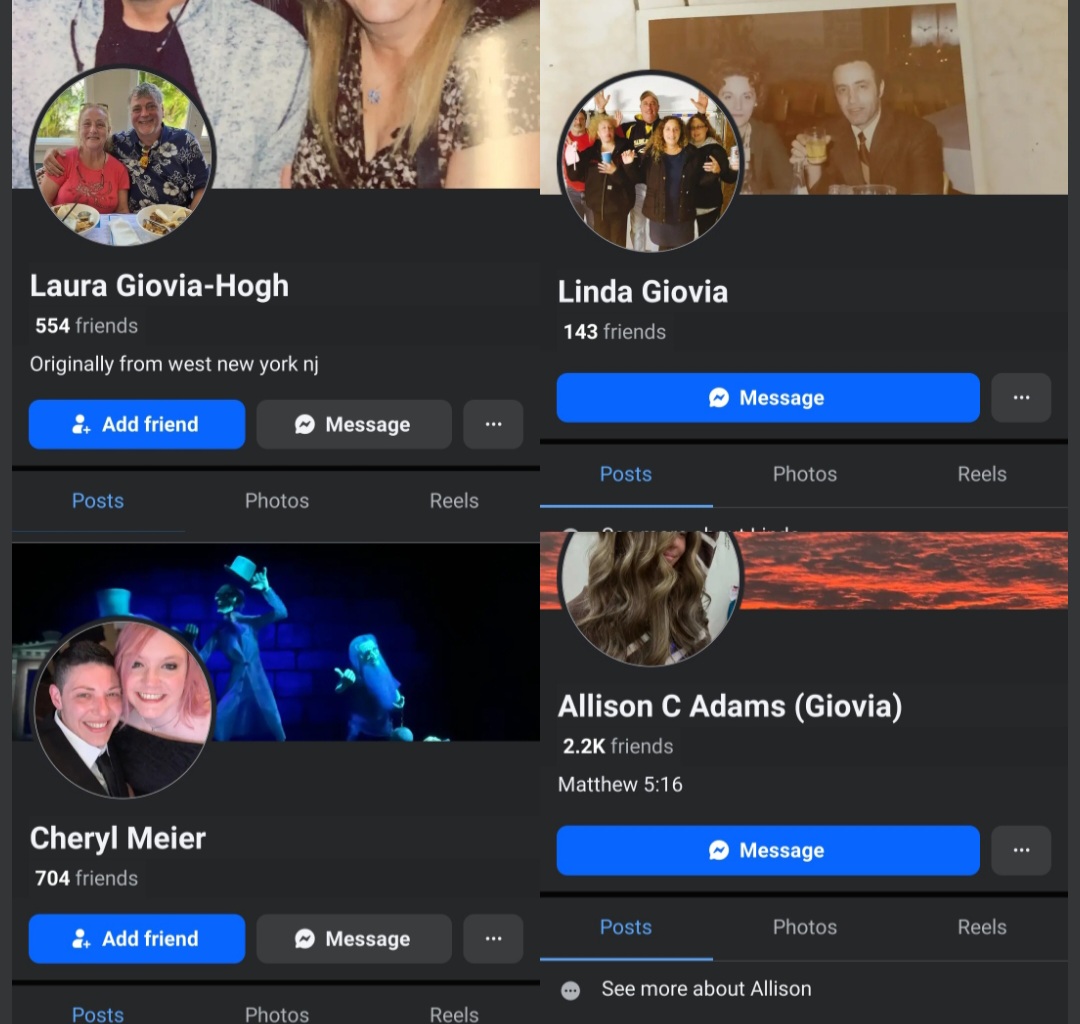
Families/Relatives included; (Tricia Molnar, Laura Glovia-Hogh, Eileen Noller Giovia, Linda Giovia, Barnabas Toth, Ashley Meier, Cheryl Meier, Allison C Adams, Tiffany Giovia, Natasha DiPietro)
2. Criminal Penalties (If Behavior Meets Criminal Thresholds) Pure verbal or non-physical sexual harassment is rarely criminalized, but if it involves threats, repeated alarming conduct, or physical contact, it may fall under N.J.S.A. 2C:33-4 (Harassment) or escalate to sexual assault/contact (N.J.S.A. 2C:14). These are distinct from civil LAD claims. Harassment (Petty Disorderly Persons Offense): Basic cases (e.g., repeated offensive communications, threats of touching, or alarming conduct with intent to harass). Up to 30 days in county jail. Fine up to $500. Aggravated Harassment (Fourth-Degree Crime): If the offender is on parole/probation, imprisoned, or targets a judge (or involves cyber-harassment with threats). Up to 18 months in state prison. Fine up to $10,000. Criminal Sexual Contact (Fourth-Degree Crime): If harassment involves intentional offensive touching of intimate parts without consent (but not penetration). Up to 18 months in state prison. Fine up to $10,000. Possible sex offender registration under Megan's Law if involving a minor. Sexual Assault (Second-Degree Crime): If it involves penetration or severe coercion. 5–10 years in state prison. Fine up to $150,000. Mandatory sex offender registration. Aggravated Sexual Assault (First-Degree Crime): Most severe cases (e.g., with weapons, minors, or extreme violence). 25 years to life in prison (with 85% parole ineligibility under No Early Release Act). Fine up to $300,000+. Lifetime sex offender registration.

Source Notes: Criminal classifications and penalties are defined in N.J.S.A. 2C:33-4 and 2C:14.327c27aec9a9c3ff8813498bb96e91 Additional Notes Statute of Limitations: For LAD claims, generally 2 years from the last incident (extendable under "continuing violation" doctrine for ongoing harassment). Criminal charges must be filed promptly based on the offense degree.

Reporting: Victims can contact the DCR (for civil), local police (for criminal), or EEOC (federal overlap). Employers must provide annual sexual harassment training or face fines. Penalties can compound (e.g., civil suit alongside criminal charges). Consult a lawyer for case-specific advice, as outcomes depend on evidence and circumstances. This information is current as of December 2025 and based on New Jersey statutes and enforcement guidelines.


Fans
Fans
Fans
Fans